

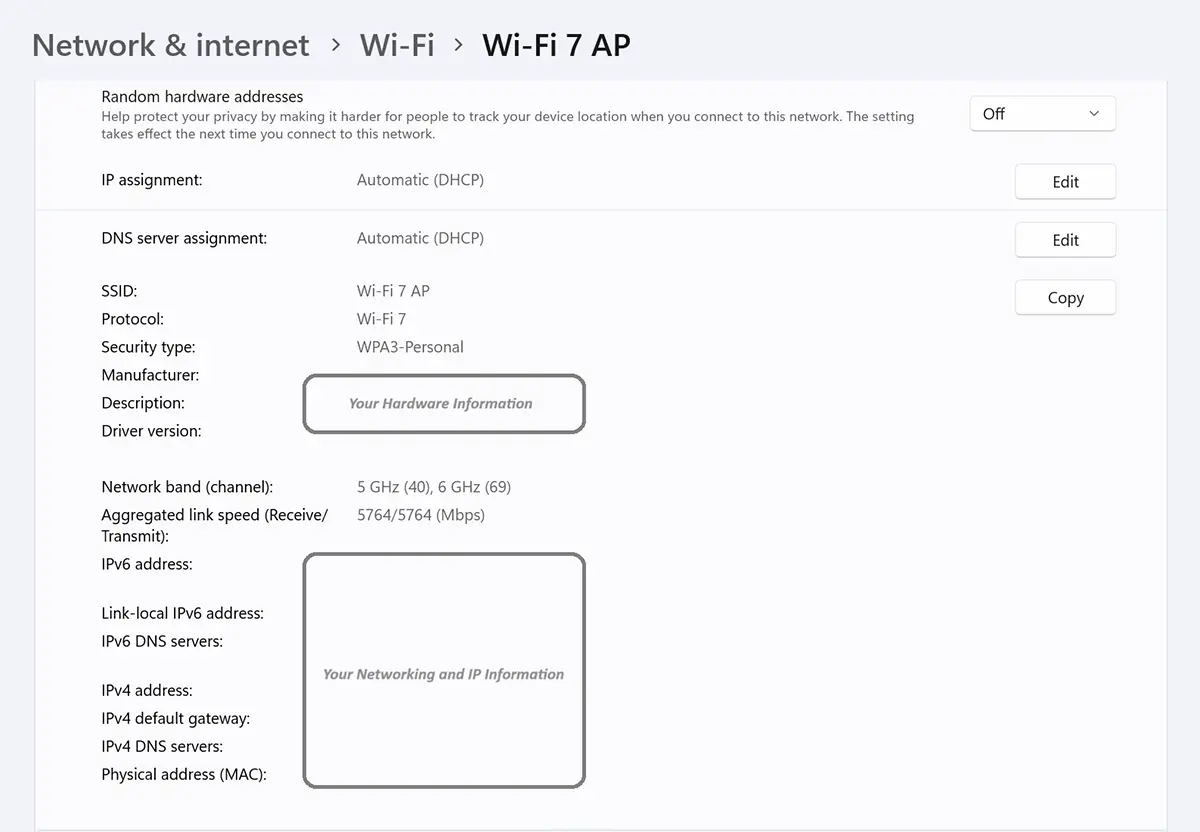
Shortly after the announcement Wi-Fi Alliance, Microsoft has integrated Wi-Fi 7 on Windows 11 for users whose computers are enrolled in the Windows 11 Insider Preview Canary Channel and Dev Channel. Thus, Windows 11 is the first operating system to support Wi-Fi 7.
As demand for connectivity grows, Wi-Fi standards must evolve to keep up. From video streaming to online gaming and remote work, we need faster and more stable internet speeds, and Wi-Fi 7 is a significant step forward in this direction.
Wi-Fi 7, also known as IEEE 802.11be Extremely High Throughput (EHT), represents a significant technological leap over previous generations of Wi-Fi. This revolutionary technology brings to the fore a number of innovative features designed to improve connectivity and user experience.
What are the advantages of Wi-Fi 7 on Windows 11
Compared to previous technologies, Wi-Fi 7 offers transfer speeds up to 4 times faster than Wi-Fi 6 and Wi-Fi 6E, and nearly 6 times faster than Wi-Fi 5. Also, the low latency provided by Wi-Fi 7 significantly improves the responsiveness and performance of real-time activities such as gaming and video conferencing.
Related: What advantages Wi-Fi 6E offers, 6 GHz 802.11Ax tape
Higher speeds: Wi-Fi 7 has the potential to deliver speeds of over 40 Gbps, 4 times higher than Wi-Fi 6E. This will allow for faster downloads, buffer-free 4K/8K video streaming, and an overall smoother online experience.
With the 4096-QAM modulation supported by Wi-Fi 7 on Windows 11, it increases data transmission efficiency by 20%, which translates into higher quality video streaming, video conferencing and other multimedia applications. These improvements bring a smoother and more enjoyable user experience for Windows 11 users, regardless of their online activities.
Increased capacity: Wi-Fi 7 is designed to handle multiple devices simultaneously, reducing network congestion and improving performance in dense environments such as stadiums, conference rooms or homes with multiple smart devices.
Lower latency: Wi-Fi 7 will significantly reduce latency, the time it takes for devices to communicate with each other. This will be beneficial for time-sensitive applications such as online gaming, virtual reality and telemedicine.
Increased energy efficiency: Wi-Fi 7 will include features that will improve the energy efficiency of devices, extending battery life for Windows 7 laptops that are Wi-Fi 7 compatible.
Wi-Fi 7 will also include other new features, such as Multi-Link Operation, which allows devices to connect to multiple access points simultaneously for better performance, and Puncturing, which allows for more efficient use of the radio spectrum. With its ultra-high bandwidth of 320 MHz in 6 GHz, Wi-Fi 7 doubles the speed to devices and opens up new possibilities for bandwidth-intensive applications such as augmented and virtual reality.
In conclusion, the integration of Wi-Fi 7 on Windows 11 is a significant step towards the future of wireless connectivity. With impressive transfer speeds, improved reliability and reduced latency, Wi-Fi 7 redefines the standards for the online experience, giving users the opportunity to enjoy high-performance wireless connectivity.
Wi-Fi 7 is still in development, but the first compatible devices are expected to appear in 2024.


You may also be interested in...
