

User Account Control (UAC), it is a new security technology introduced by Microsoft, for the first time on Windows Vista operating systems. This aims to improve the security of Microsoft Windows, by limiting the launch of soft applications by a user who has no administrator privileges. Upon installation of the operating system Windows Vista, the user who created has administrator privileges, but this cannot launch an application without it not being approved by the administrator.
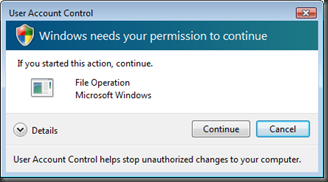
“Windows needs your permission to continue“, is the message given by UAC Each time it is wanted to launch an executable that was not installed by the administrator. If you have to install a software, on the installation kit right-click and see the option “Run as administrator… ” . This option installs the program under the privileges of System Administrator.
By introducing the UAC in the operating systems, the possibility of infection with malware and rootkituri. Basically, no application can be launched without the agreement of the admin.
Uac, play and role of anti virus / anti-rootkit. A few months ago, two IT magazines in Germany, published the results of a security test made by AV-Test.org . The purpose of the test was to show how well they are protected against rootkits, systems Windows Vista (Uac, incorporated) compared to Windows XP .
The 30 most known rootkits were used for the tests. On Windows XP, none of the system's protection measures could stop the rootkits. All 30 managed to run. On Vista, Only six rootkit-uri managed to run, under the conditions in which Uac was disabled . After Activation of UAC, all rootkits were identified and stopped on time .
Despite the many criticisms that Microsoft faced, at the launch of Windows Vista, UAC is an essential feature of the operating system, which ensures stability and security.


You may also be interested in...
